Sport4All First Nations Artwork
A Story of Inclusion: Sport4All's First Nations Artwork by Uncle Paul Calcott.
At Sport4All, our First Nations artwork is more than a visual identity. It tells a story of inclusion, connection and belonging, reflecting the values that guide our work in communities across Australia.
Created by proud Wiradjuri Elder Uncle Paul Constable Calcott, the artwork captures Sport4All’s commitment to creating opportunities where everyone can participate, contribute and belong. Through symbols, pathways and meeting places, it represents the diversity of people, cultures and lived experiences that strengthen our communities, while recognising the importance of listening, learning and building genuine relationships.
Uncle Paul has created a meaningful piece that reflects the spirit of Sport4All and the role community plays in creating more inclusive places for everyone.
At the centre of the artwork is an Aboriginal and Torres Strait Islander person with disability, represented by a black U-shaped symbol. Surrounding this central figure is a circle of people, depicted through U-shaped symbols in the colours of Get Skilled Access (GSA) and the Sport4All program. Together, they represent community, connection and the collective support that helps create environments where everyone has the opportunity to participate and belong.
Along the bottom of the artwork, there are 5 red tracks outlined in white with different footprints in each, which lead up to the symbols representing our organisation. The track on the left is a footprint with a walking stick print representing someone who uses a walking aid, the next track to the right shows’ wheelchair tyre track marks and the track second from the right has footprints alongside dog paw prints which represent people using assistance dogs. The track in the middle and the track to the very right have footprints that look like everybody else’s, which represent people with non-visible disabilities, for example, neurodiversity, psychosocial, and intellectual disability.
In between these tracks, there are areas that represent the different Countries within Australia that people are coming from to join Sport4All, including the orange desert area and mountains on the far right which represent desert dreaming country. The next area to the left has a light blue freshwater stream with green grass alongside it which represents freshwater country. The dark green area to the left shows the view looking down at all the canopies of the trees which represent rainforest areas and hinterland, and an area on the very left side with dark and light blue waves which represent the saltwater people.
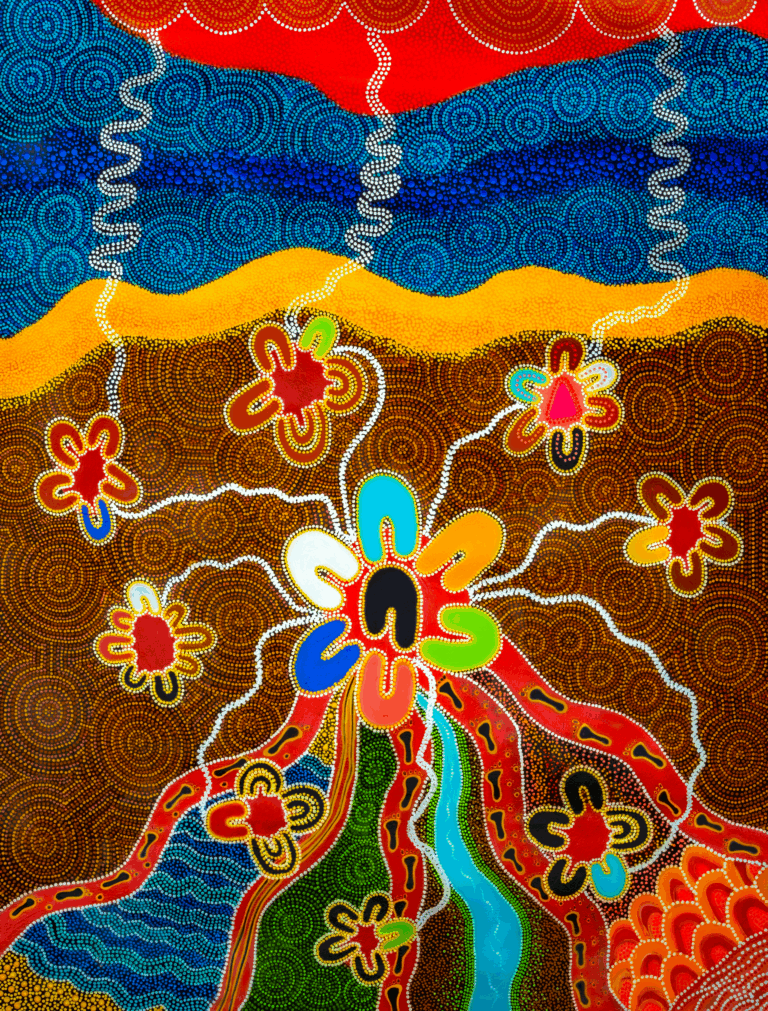
There are white trails from our organisation in the centre that lead down to smaller circles of different coloured U-shaped symbols placed along the different Country areas of Australia. This represents our team going out to connect with those communities and sitting and having a yarn with the people from the different areas, talking about disability in sport and encouraging them to participate.
Along the centre of the artwork surrounding our Organisational circle, is a brown background with different-sized dark brown circles all connecting to each other. This represents the urban area and the many different language groups and community groups coming together and linking with each other. Again, there are white trails connecting our organisation in the middle with smaller circles of different coloured U-shaped symbols. This represents our team going out and connecting with and supporting the people in different communities within the urban area.
Above the brown urban area at the top of the artwork is red land with white half circles lined up along the top edge. These represent the people from overseas who have come from countries far away. Below this is the deep salt water, a long dark blue wave that runs horizontally along the width of the artwork and sits in between some light blue waves, with the bottom wave meeting the yellow shore below it. There are three white zig-zag lines connecting from the white circles at the top and moving down over the blue saltwater waves and yellow shore, into the brown urban area where they join into the different communities of people, the smaller circles of different coloured U-shaped symbols. This represents that many people had a really long journey travelling across deep salt water. They then reached our shores and went to connect with their community. There are white trails connecting our organisation with these communities, which represents our team going out to Culturally and Linguistically Diverse Communities to talk to people about our story, sport and disability, and to listen to their stories and what support they might need from us.
Within some of these communities are pink triangles and pink dots showing that our team also communicates with and listens to the LGBTQI+ community.
The yellow dots around each person, and the U-shaped symbols represent our commonality, no matter what our culture is or where we are from, we all have the same flesh underneath our skin. Yellow is the colour of the sun in the Aboriginal flag which represents life, and that we are all living people. The white lining around the outside of each of the communities bonds everyone together. White is often used in celebration on Aboriginal and Torres Strait Islander Peoples bodies and represents their bones and that they are what hold us together. The white lining in this artwork therefore represents the link that connects all our cultures and communities, while our organisation Get Skilled Access is placed in the middle of the artwork as the common denominator to help bring everyone together.
About Uncle Paul Constable Calcott:
Uncle Paul Constable Calcott is a proud Wiradjuri man and artist living with a disability on Gubbi Gubbi Country. Through his art, Uncle Paul narrates his journey as an Aboriginal man with a disability in urban Australia. With thirty years of experience in the disability sector, he is dedicated to ensuring that First Nations peoples with disabilities have access to the services and supports they need to thrive.
We invite you to explore Uncle Paul’s Art Studio, Hotpink Goanna, at Hotpink Goanna
We are incredibly grateful to Uncle Paul for his exceptional work, which beautifully embodies Sport4All’s commitment to inclusion and reconciliation.
Related Blogs